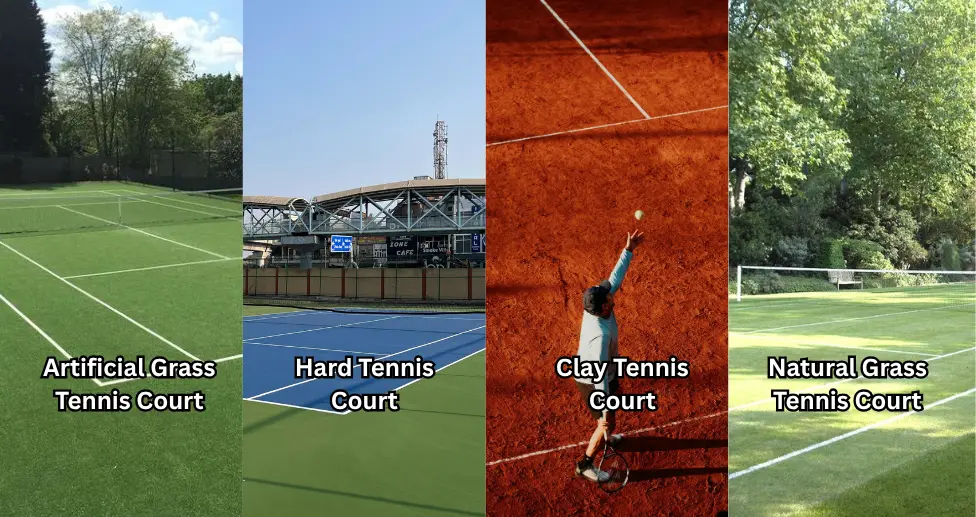
The surface beneath your feet shapes every rally, every bounce, and every match outcome. Yet surface selection is one of the most overlooked decisions in court construction—often made on aesthetics or budget alone, rather than on performance data, climate conditions, or player requirements.
This guide breaks down every major type of tennis court surface in use today: how each one performs, who it suits, what it demands in terms of maintenance, and how it measures up against ITF standards. Whether you’re evaluating options for a new facility or comparing surfaces for a renovation project, this is the reference you need.
The 4 Main Types of Tennis Court Surfaces
The International Tennis Federation (ITF) categorizes court surfaces into five pace ratings, from ITF 1 (slow) to ITF 5 (very fast). Most surfaces in use today fall into one of four primary categories: clay, hard court, grass, and artificial/synthetic. Each category has distinct subcategories, and the differences within those groups are just as important as the differences between them.
Clay Courts: Slow Pace, High Spin, Maximum Rally Length
ITF Pace Rating: 1–2 (Slow to Medium-Slow)
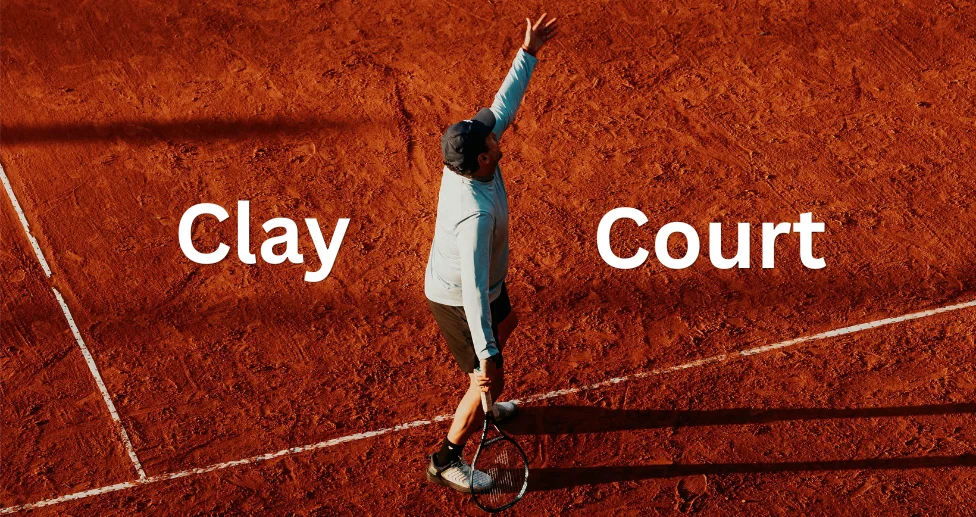
Clay is the most widely used court surface in Europe and South America. It slows the ball significantly, creates a high bounce, and rewards baseline players who rely on topspin, consistency, and physical endurance.
Red Clay (Crushed Brick or Shale)
Red clay—most commonly made from crushed brick, tile, or shale—is the surface of Roland Garros and the Spanish and South American club circuit. It delivers a predictable, high bounce and a notably slower game pace.
Key characteristics:
- High friction surface that generates significant topspin response
- Ball mark visibility allows line-call disputes to be resolved on-court
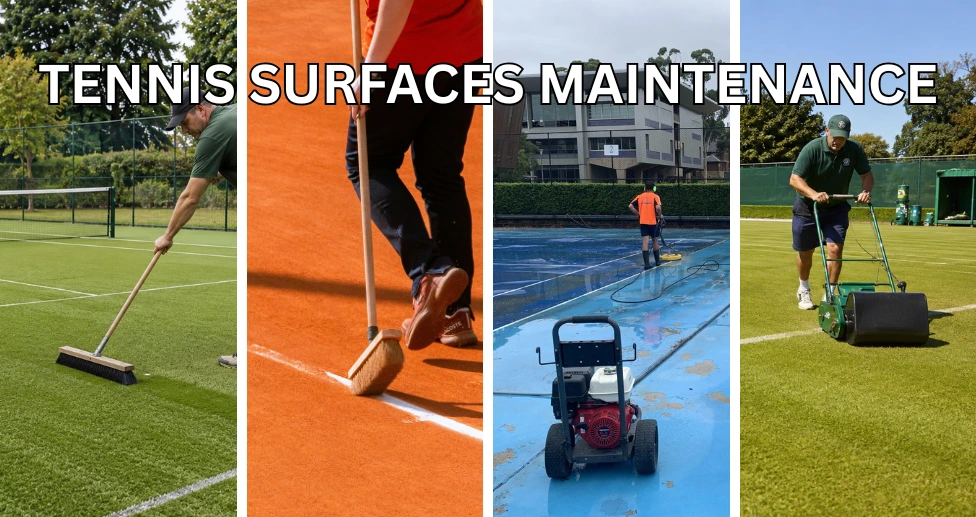
- Requires regular rolling, watering, and topping up with loose material
- Drains poorly in heavy rain; surface must be re-leveled after downpours
- Lifespan of 10–25+ years with consistent maintenance
Green Clay (Har-Tru)
Har-Tru, or American clay, is made from crushed metabasalt (greenstone). It is lighter than red clay and drains faster, making it a practical alternative for outdoor courts in wetter climates.
Key characteristics:
- Slightly faster pace than red clay; ball skids more on the surface
- Better natural drainage than red clay
- Common in U.S. club and recreational facilities
- Requires daily watering and grooming to maintain playability
Hard Courts: Versatile, Durable, and Widely Used
ITF Pace Rating: 3–4 (Medium to Medium-Fast)
Hard courts are the most common surface globally—used at the US Open, Australian Open, and the majority of public and commercial facilities worldwide. They offer a consistent, predictable bounce and require less maintenance than natural surfaces.
Asphalt Hard Courts
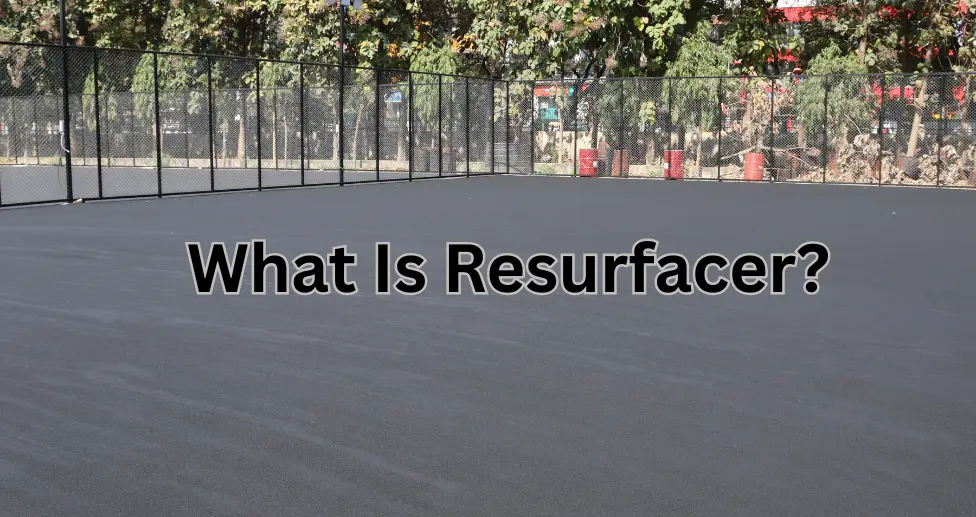
Asphalt base courts are the most cost-effective hard court option. They provide a stable, durable foundation that can be topped with acrylic coatings to adjust speed and texture.
Key characteristics:
- High durability; withstands heavy foot traffic and varied weather conditions
- Prone to cracking over time due to ground movement and UV exposure
- Requires resurfacing every 4–8 years depending on climate and use
- Speed and cushioning depend on the acrylic coating system applied on top
Concrete Hard Courts
Concrete courts are harder and more rigid than asphalt, offering excellent dimensional stability over time. They are less likely to crack or heave but transmit more impact force to players’ joints.
Key characteristics:
- Extremely low maintenance once sealed and coated
- More expensive to construct than asphalt
- Reduces ball irregularity due to a highly uniform surface
- Requires expansion joints to manage thermal movement
Acrylic Coatings on Hard Courts
Both asphalt and concrete courts are typically finished with an acrylic resurfacing system. These coatings determine the final playing speed, grip level, and color of the court.
Acrylic coating speed options:
| Coating Type | Sand Texture | ITF Speed Rating | Typical Use |
| Cushioned acrylic | Light | 3 (Medium) | Club and recreational |
| Standard acrylic | Medium | 3–4 (Medium-Fast) | Multi-use facilities |
| Textured acrylic | Heavy | 4–5 (Fast) | High-traffic/outdoor |
Grass Courts: The Fastest Natural Surface in Tennis
ITF Pace Rating: 4–5 (Fast to Very Fast)
Natural grass courts are the oldest and most prestigious tennis surface, synonymous with Wimbledon and the traditional British summer season. The ball stays low and skids through quickly, rewarding serve-and-volley tactics and flat, aggressive groundstrokes.
Natural Grass Courts
Natural grass requires more intensive maintenance than any other court surface. Consistent mowing, watering, fertilization, aeration, and overseeding are essential to keep the surface playable and compliant with ITF standards.
Key characteristics:
- Very fast ball speed with a low, unpredictable bounce
- High wear in central service and baseline zones
- Seasonal availability limited to dry, warm months
- Construction and maintenance costs are the highest of all surface types
- ITF recommends Perennial Ryegrass blends for professional-standard courts
Artificial and Synthetic Surfaces: Performance Without the Maintenance Burden
ITF Pace Rating: Varies (1–5 depending on system)
Synthetic surfaces have evolved significantly. Modern artificial turf, modular court systems, and acrylic alternatives now closely replicate the performance characteristics of natural surfaces—with far lower upkeep requirements.
Artificial Grass (Synthetic Turf)
Artificial grass courts use a carpet of synthetic fibers—typically nylon or polypropylene—infilled with sand or rubber granules. The infill volume and fiber height control the playing speed.
Key characteristics:
- Speed is adjustable based on infill density (more infill = slower pace)
- Suitable for year-round outdoor play in most climates
- Moderate maintenance: brushing, infill top-up, and cleaning
- Softer underfoot than concrete or asphalt; reduced joint stress
- Common in recreational clubs, schools, and multi-sport facilities
Artificial grass infill comparison:
| Infill Type | Pace Effect | Typical Application |
| Sand-only | Slower | Recreational/club courts |
| Sand + rubber | Medium | Multi-use sport facilities |
| Rubber-only | Faster | Dedicated tennis courts |
Modular Court Systems (Interlocking Tiles)
Modular courts use rigid or semi-rigid interlocking tiles—usually made from polypropylene—installed over a flat base. They are portable, quick to install, and suitable for indoor and outdoor use.
Key characteristics:
- Consistent bounce response across the entire court surface
- High shock absorption; recommended for players with joint concerns
- Minimal maintenance; tiles can be individually replaced if damaged
- ITF-certified modular systems are available for competition use
- Used in temporary professional event setups and permanent indoor facilities
Head-to-Head: Comparing All Surface Types
| Surface | ITF Speed | Maintenance Level | Durability | Cost Range | Best For |
| Red Clay | Slow | High | 10–25+ years | Medium | Club, training, recreational |
| Har-Tru (Green Clay) | Slow–Medium | High | 10–20 years | Medium | U.S. clubs, humid climates |
| Asphalt + Acrylic | Medium–Fast | Low–Medium | 4–8 years resurfacing | Low–Medium | Public, multi-use, recreational |
| Concrete + Acrylic | Medium–Fast | Low | 10–15+ years | Medium–High | Commercial, high-traffic facilities |
| Natural Grass | Fast | Very High | Seasonal | High | Prestige clubs, professional events |
| Artificial Grass | Varies | Low–Medium | 8–12 years | Medium | Year-round clubs, schools |
| Modular Tiles | Medium–Fast | Very Low | 10–20 years | Medium–High | Indoor, temporary, multi-sport |
How Playing Style Should Inform Surface Selection
Surface selection affects more than maintenance budgets. It directly shapes the style of play that develops in players who train on a given court—and the physical demands placed on their bodies.
Clay Courts and Baseline Development
Players who train primarily on clay tend to develop superior defensive skills, footwork, and topspin mechanics. The slower pace of clay encourages longer rallies, deeper court positioning, and stronger physical conditioning. Facilities focused on player development often favor clay for this reason.
Hard Courts and Versatility
Hard courts produce a balanced, consistent playing environment. The ball bounces true, rallies are medium-length, and most playing styles remain competitive. This versatility makes hard courts the logical choice for multi-purpose facilities that serve a broad range of players and skill levels.
Artificial Surfaces and Year-Round Accessibility
For facilities in wet or cold climates, artificial surfaces—particularly modular tile systems and artificial grass—offer consistent playability regardless of season. Eliminating weather-related court closures protects revenue, maximizes court utilization, and extends player development time.
ITF Standards and Surface Certification: What Facility Operators Need to Know
The ITF’s Court Pace Classification (CPC) program provides an independent, standardized framework for measuring and certifying court speed. Courts are tested using the ITF Rebound Ace Pace Rating methodology, which measures ball speed reduction and bounce height on impact.
ITF pace categories:
- ITF 1: Slow (clay, some cushioned hard courts)
- ITF 2: Medium-Slow
- ITF 3: Medium (most standard hard courts)
- ITF 4: Medium-Fast
- ITF 5: Fast (grass, carpet, low-infill artificial turf)
For competitive facilities hosting sanctioned events, surface certification under the ITF CPC program is a formal requirement. Even for non-competitive facilities, selecting an ITF pace-rated surface ensures the playing experience meets a recognized global standard.
Conclusion: Choose the Right Surface & Unlock Your Court’s Full Potential
Every surface category covered in this guide offers a distinct set of trade-offs: speed, durability, maintenance burden, cost, and player experience. The right choice depends on your facility’s climate, budget, usage volume, and the type of tennis you want to support.
Red clay rewards patience and long-term player development. Hard courts deliver consistency and low operating costs. Artificial surfaces prioritize year-round access and minimal upkeep. Natural grass remains the benchmark for prestige.
Understanding the differences is the first step. Applying that knowledge to your specific context is where the real decision-making begins.
If you’d like more detailed technical information on specific surface systems or product specifications, feel free to reach out to the TennisCourtFlooring team. We’re happy to provide product-level details to help inform your planning.