tenniscourtflooring.com

Tennis Court Construction: A Complete Guide for Every Surface

Explore the essential aspects of tennis court construction, from site preparation and base requirements to surface selection, drainage, dimensions, and finishing details for a durable and playable tennis court.

What Is Tennis Court Construction?

Tennis court construction involves several steps that turn a prepared site into a complete playing facility. First, the construction team assesses the site, prepares the foundation, and plans proper drainage. Next, workers build the selected court surface according to its specific requirements. During construction, the team checks the court slope, base condition, and surface quality to create a stable playing area. In addition, each court type requires different materials and preparation methods. For example, clay courts need suitable soil and drainage, while natural grass courts need healthy turf and regular watering. Artificial grass courts also need a stable foundation, proper drainage, and suitable base materials. Finally, careful construction helps the court perform well and maintain its quality over time.

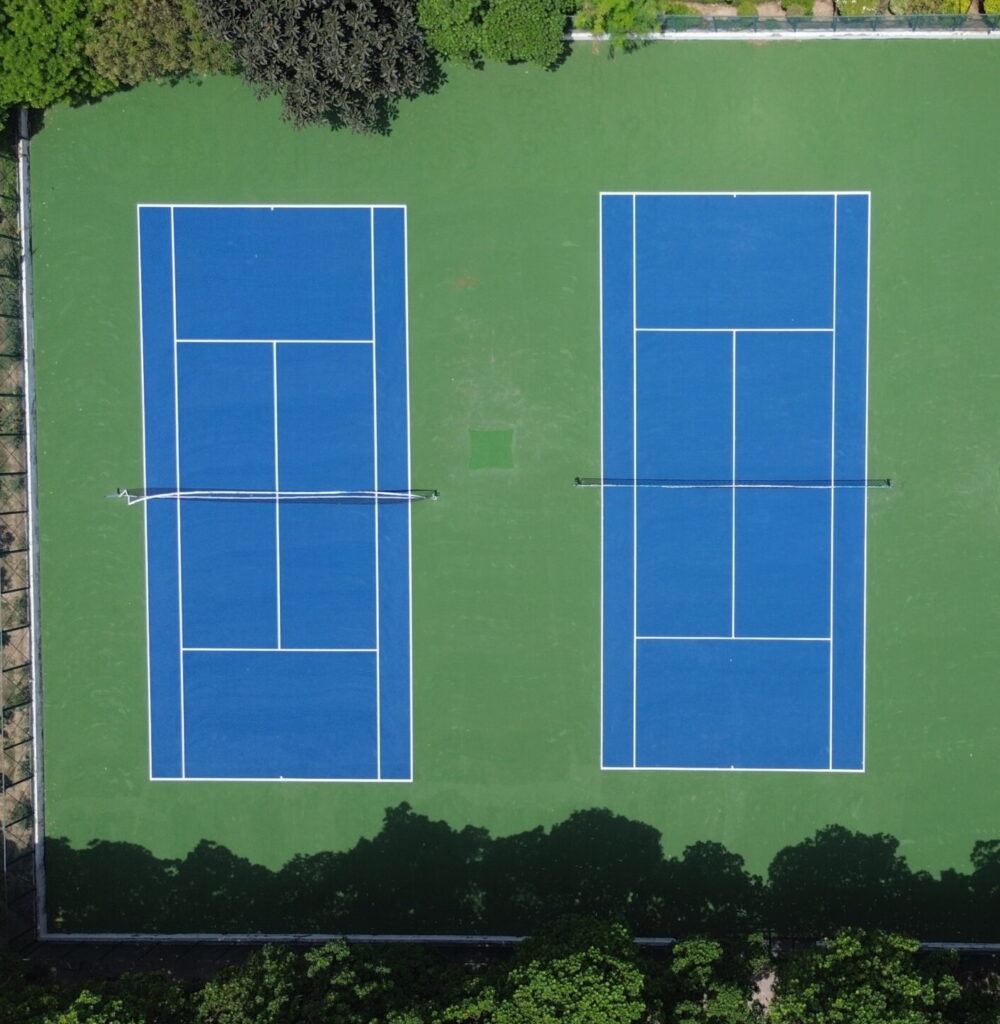
Acrylic Hard Court Installation Process

An acrylic hard court needs a strong base and carefully planned surface layers. First, the construction team prepares the asphalt or concrete base and checks its condition. Next, workers repair cracks and apply the required primer. Then, the team builds the acrylic layers to create a smooth and consistent playing surface. Finally, workers complete the color coating and court markings.

Asphalt / Concrete Base

The construction team prepares a stable asphalt or concrete base before starting the acrylic surface layers.

Base Repair & CC Primer

Next, the team repairs cracks and surface imperfections before applying the primer for better adhesion.

Resurfacer

The team applies resurfacer to create a smooth base and prepare the court for the next coating layers.

Pro-Master Cushion

After that, the team adds a cushion layer to reduce surface impact and improve playing comfort..

Filler & Top Prime Color Coats

Multiple acrylic color layers create the desired surface texture, appearance, and playing characteristics.

White Line Marking

Finally, the team applies accurate white lines to define the singles, doubles, and service areas of the court.

Clay Court Installation Process

A clay court requires careful site preparation, drainage, aggregate layers, and surface materials. First, the team prepares the site and foundation. Next, they build the stone base and drainage system. Finally, they add the clay surface, mark the court lines, and compact the playing area.

Site Preparation & Foundation

The team clears, excavates, levels, and grades the site to create proper water runoff.

Drainage & Borders

The team installs perimeter curbs & subsurface drainage systems to manage excess water & protect the court.

Stone Base Layers

The team places and compacts coarse stone and finer aggregate layers to create a stable foundation.

Surface Material Application

The team adds suitable clay or crushed stone layers and finishes the surface with the required top layer.

Line Installation

The team marks the court lines accurately and follows the required court layout.

Watering & Rolling

Finally, the maintenance team waters and rolls the surface to create a firm, smooth, and consistent playing area.

Natural Grass Court Installation Process

A natural grass court requires careful soil preparation, drainage, irrigation, and root-zone management. First, the team prepares the site and soil. Next, they establish the grass and maintain proper moisture. Finally, regular mowing, watering, rolling, and leveling help maintain a smooth and consistent playing surface.

Site Preparation & Foundation

The team clears, excavates, levels, and grades the site to create proper water runoff.

Drainage & Irrigation

The team installs drainage & irrigation systems to remove excess water and maintain healthy grass growth.

Soil & Root Zone Preparation

The team prepares suitable topsoil and root-zone materials to support healthy and consistent grass growth.

Grass Installation

The team selects suitable natural grass and establishes it carefully across the prepared court area.

Line Installation

The team marks the court lines accurately and follows the required court layout.

Mowing, Watering & Rolling

The grass is regularly mowed, watered, fertilized, & rolled to maintain a smooth, level, & consistent playing surface.

Artificial Grass Court Installation Process

An artificial grass court requires proper site preparation, drainage, a compacted aggregate base, synthetic turf, infill, and accurate line marking. First, the team prepares the subgrade and drainage system. Next, they build the aggregate base and install the synthetic grass. Finally, they add infill, mark the court lines, and complete the final brushing and finishing.

Site Preparation & Subgrade

The team clears, excavates, levels, and compacts the site to create a stable foundation.

Drainage & Base Preparation

A suitable drainage system & compacted aggregate base are installed to provide stability & allow efficient water flow.

Aggregate Base Layers

The team places and compacts graded stone and fine aggregate layers to create a firm and permeable foundation.

Artificial Grass Installation

The team lays synthetic grass over the prepared base and joins individual sections to create a smooth, uniform playing surface.

Infill & Line Installation

Suitable infill material is applied where required, while accurate tennis court lines are integrated into or installed on the synthetic surface.

Brushing & Final Finishing

Finally, the team brushes and levels the artificial grass to distribute the infill evenly and create a consistent playing surface.

Scroll to Top