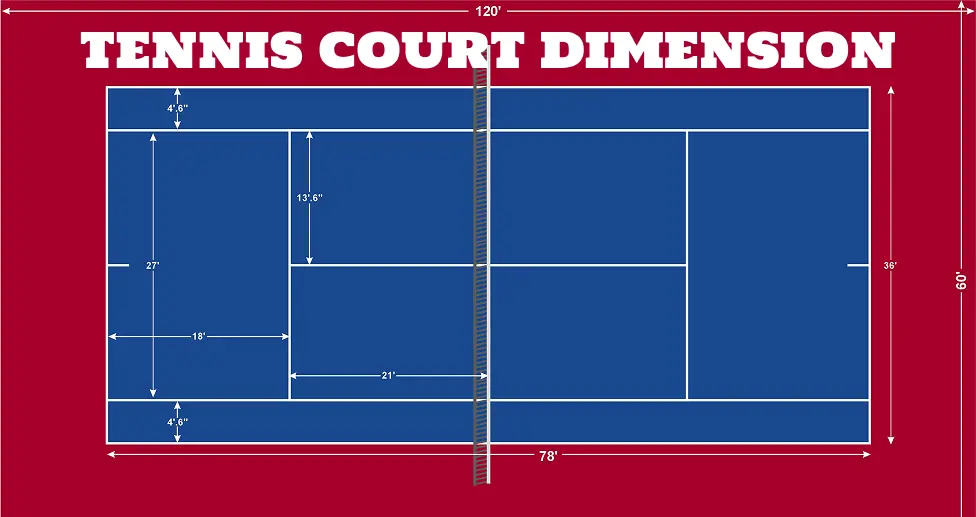
Quick answer: A standard tennis court measures 78 feet (23.77 m) long and 27 feet (8.23 m) wide for singles, expanding to 36 feet (10.97 m) wide for doubles. Net height is 3 feet (0.914 m) at the center and 3.5 feet (1.07 m) at the posts. All dimensions are governed by the International Tennis Federation (ITF).
Whether you’re planning a new tennis facility, resurfacing an existing court, or simply trying to understand what separates a regulation-compliant court from a substandard one, dimensions are where everything begins. Get them wrong, and you compromise gameplay, player safety, and facility credibility. Get them right, and you lay the foundation for a court that performs as well as it looks.
Tennis court dimensions aren’t arbitrary. They’re the result of over a century of refinement, governed today by strict International Tennis Federation (ITF) standards that apply to every level of play—from your local recreation center to the courts at Wimbledon. Yet despite their importance, dimension planning remains one of the most commonly misunderstood aspects of tennis court construction.
This guide covers everything you need to know about tennis court dimensions: singles and doubles measurements, net specifications, clearance zones, line widths, surface types, and the planning mistakes that catch even experienced builders off guard. Each section is designed to give you practical, accurate information you can act on—whether you’re a court developer, facility manager, or sports infrastructure professional.
By the end of this article, you’ll have a complete reference guide for standard tennis court dimensions, grounded in ITF regulations and real-world construction requirements.
Understanding Tennis Court Dimensions
Why Do Tennis Court Dimensions Matter?
Tennis court dimensions aren’t just a technicality—they directly affect how the game is played. A court that’s even a few centimeters too narrow or too short will alter ball bounces, service angles, and player movement in ways that are immediately noticeable to experienced players.
For facility operators, non-compliant dimensions can disqualify a venue from hosting sanctioned tournaments. For recreational facilities, incorrect measurements reduce the long-term value of the investment. And for players, dimensions that don’t meet standard create muscle memory issues—particularly for competitive athletes who train across multiple venues.
Beyond gameplay, dimensions also determine construction costs. A court that’s too generously sized wastes material; one that’s too small may require expensive modifications down the track. Getting the numbers right from the outset is the single most important step in tennis court planning.
ITF Standards Overview
The International Tennis Federation (ITF) is the global governing body responsible for setting and maintaining the rules that define tennis court dimensions. The ITF’s official regulations are published in the Rules of Tennis and the ITF Court Pace Classification Programme (CPCP), both of which are updated periodically to reflect current standards.
According to the ITF, all regulation tennis courts must meet the following core specifications:
- Court length: 78 feet / 23.77 meters (same for singles and doubles)
- Court width (singles): 27 feet / 8.23 meters
- Court width (doubles): 36 feet / 10.97 meters
- Net height at center: 3 feet / 0.914 meters
- Net height at posts: 3.5 feet / 1.07 meters
These measurements define the in-play area. Total court area—including run-off zones and clearance margins—extends well beyond these boundaries, and any comprehensive construction plan must account for both.
The ITF also provides guidance on surface pace, drainage, court orientation, and lighting, all of which interact with the physical dimensions of the court. This article focuses specifically on dimensional standards, but these broader ITF guidelines are equally important for full regulatory compliance.
Singles Court Dimensions
Length and Width for Singles Play
A regulation singles tennis court measures 78 feet (23.77 meters) in length and 27 feet (8.23 meters) in width. These dimensions apply universally across all surface types—hard court, clay, grass, and synthetic acrylic—and at all levels of competitive play, from club level to Grand Slam events.
The 78-foot length is divided equally by the net into two halves, each measuring 39 feet (11.885 meters) from the net to the baseline. This symmetrical layout ensures that both players compete from identical spatial conditions.
The 27-foot width defines the playable boundary for singles matches. The sidelines that mark this boundary are called the singles sidelines, and any ball that lands outside these lines is considered out of play during a singles match.
It’s worth noting that while the playing surface must be uniform across the entire court, the lines themselves must be precisely marked within tight tolerances. A variance of even a few centimeters in the sideline position can affect the outcome of close line calls—particularly at the professional level where hawk-eye and ball-tracking technology is used to verify calls.
Service Boxes and Their Dimensions
The service box is the rectangular zone in which a served ball must land for the serve to be considered valid. Each side of the court contains two service boxes—one on the left (ad side) and one on the right (deuce side).
Key service box measurements:
- Distance from net to service line: 21 feet / 6.4 meters
- Width of each service box: 13.5 feet / 4.115 meters
- Total service line width (both boxes combined): 27 feet / 8.23 meters
The center service line bisects the two service boxes, running perpendicular to the net from the net strap to the service line. This line must be 2 inches (5 cm) wide, matching the standard for most court markings.
The service boxes are among the most-used zones on the court. Because every point begins with a serve, accurate service box dimensions are critical to fair play. Inaccurate positioning of the service line—even by a few centimeters—can make the service box either too deep or too shallow, affecting serve trajectory and fault rates.
Key Measurements Breakdown
| Measurement | Imperial | Metric |
| Total court length | 78 ft | 23.77 m |
| Court width (singles) | 27 ft | 8.23 m |
| Net to service line | 21 ft | 6.4 m |
| Service box width | 13.5 ft | 4.115 m |
| Baseline to service line | 18 ft | 5.485 m |
| Center mark length | 4 inches | 10 cm |
| Half-court length (net to baseline) | 39 ft | 11.885 m |
Doubles Court Dimensions
Additional Width for Doubles Play
The doubles court uses the same 78-foot length as the singles court but expands to a width of 36 feet (10.97 meters). This additional 9 feet (2.74 meters) of width—4.5 feet (1.37 meters) on each side—accommodates the wider court coverage required when two players occupy each half.
Unlike singles, doubles play engages the full 36-foot width for all rallies after the serve. This significantly changes court geometry, particularly in terms of angle creation, lateral movement, and team positioning. From a construction standpoint, both the singles and doubles sidelines must be accurately marked on the same court surface, allowing the facility to host both formats.
The net used in doubles play spans the full width of the doubles court. Net posts are positioned 3 feet (0.914 meters) outside the doubles sideline on each side, giving a total net post span of 42 feet (12.80 meters) from post to post.
Doubles Alleys Explained
The doubles alley—also called the “tramline” in British English—is the narrow strip of court between the singles sideline and the doubles sideline. Each alley measures 4.5 feet (1.37 meters) wide and runs the full length of the court (78 feet / 23.77 meters).
During a doubles match, the alleys are considered in-play during all rallies after the serve is struck. However, during the serve itself, the doubles alley is out of play—the served ball must land within the service box boundaries, which remain the same as in singles.
This distinction is a common source of confusion for recreational players. Understanding it correctly requires knowing not just where the lines are, but what they mean at each stage of the point.
From a marking perspective, both the singles sideline and doubles sideline must be clearly visible and consistently colored. ITF guidelines specify that line contrast must be sufficient for players to distinguish boundaries clearly under competitive playing conditions.
Net Dimensions and Height Specifications
The tennis net is one of the most precisely regulated elements of a tennis court. ITF rules specify both height and structural requirements that must be met for competitive play.
Standard net height specifications:
| Position | Height (Imperial) | Height (Metric) |
| Net at center | 3 ft | 0.914 m |
| Net at posts | 3.5 ft | 1.07 m |
| Net post height | 3.5 ft | 1.07 m |
| Net post distance from doubles sideline | 3 ft | 0.914 m |
The net is held at its center by a net strap, which is a white band that anchors the net to the ground and maintains the required 3-foot center height. The strap must be no wider than 2 inches (5 cm).
The net band—the white tape that runs across the top of the net—must be between 2 and 2.5 inches (5–6.35 cm) wide. This band serves both a visual and structural purpose, providing a clear upper boundary that players can use as a reference during play.
Net cord or cable runs through the top of the net and connects to the posts. The cord itself must be no more than 1/3 inch (0.8 cm) in diameter. Nets that are too loose or too tightly strung will not maintain the correct center height, leading to inconsistent play conditions.
For singles matches played on a doubles-width court, two singles sticks are placed on the court at a height of 3.5 feet (1.07 m). These sticks are positioned 3 feet (0.914 m) outside the singles sideline on each side, effectively narrowing the net to singles width without requiring a separate net installation.
Baseline, Service Line, and Center Mark Explained
Every line on a tennis court has a specific purpose, and each must be accurately positioned and dimensioned. Here’s a breakdown of the key horizontal and vertical court lines:
Baseline
The baseline is the line at each end of the court that defines the back boundary of the playing area. It runs parallel to the net and spans the full 36-foot (10.97-meter) width of the doubles court. Players serve from behind the baseline and are considered “in” as long as their foot does not touch or cross the baseline at the moment of serve contact.
Center Mark
The center mark bisects each baseline at its midpoint. It measures 4 inches (10 cm) in length and extends inward toward the net. The center mark divides the baseline into two equal halves and determines which half of the court a player must serve from during each point. Players must serve from the appropriate half, standing behind the baseline and to the right or left of the center mark.
Service Line
The service line runs parallel to the net at a distance of 21 feet (6.4 meters) from the net on each side. It defines the far boundary of the service box. A serve that lands beyond the service line is a fault.
Center Service Line
Running perpendicular to the net and to the service line, the center service line bisects both service boxes. It extends from the net to the service line and is 2 inches (5 cm) wide.
Sidelines
- Singles sidelines: Define the 27-foot playing width for singles matches
- Doubles sidelines: Define the 36-foot playing width for doubles matches
- Both sets of sidelines run the full 78-foot length of the court
Comparison Table – Singles vs Doubles Court Dimensions
| Feature | Singles Court | Doubles Court |
| Court length | 78 ft / 23.77 m | 78 ft / 23.77 m |
| Court width | 27 ft / 8.23 m | 36 ft / 10.97 m |
| Alley width (each side) | N/A | 4.5 ft / 1.37 m |
| Net span | 33 ft / 10.06 m | 42 ft / 12.80 m |
| Net height (center) | 3 ft / 0.914 m | 3 ft / 0.914 m |
| Net height (posts) | 3.5 ft / 1.07 m | 3.5 ft / 1.07 m |
| Net post position | 3 ft outside singles line | 3 ft outside doubles line |
| Service box width | 13.5 ft / 4.115 m | 13.5 ft / 4.115 m |
| Service line depth | 21 ft / 6.4 m from net | 21 ft / 6.4 m from net |
| Total playing area | 2,106 sq ft / 195.7 m² | 2,808 sq ft / 260.9 m² |
Note: Service box dimensions remain identical in both singles and doubles formats. The alley zones do not contain service boxes.
Surface Types and How They Affect Tennis Court Dimensions
Court dimensions are standardized across all surface types. However, the surface you choose significantly affects how those dimensions are experienced in practice. Ball speed, bounce height, and player movement all vary by surface—making surface selection an integral part of court planning, even if the physical markings remain the same.
Hard Courts
Hard courts—typically asphalt or concrete bases topped with an acrylic surface layer—are the most widely used court surface globally. According to the ITF, hard courts make up approximately 67% of all tennis courts worldwide. The US Open and the Australian Open are both played on hard courts.
Hard courts offer a medium-to-fast pace, with a predictable, consistent bounce. The surface dimensions and markings are typically applied using acrylic paint systems, which adhere well to both asphalt and concrete substrates.
One key consideration for hard court planning: concrete and asphalt base materials require precise grading to achieve the correct slope for drainage. A standard fall of 1:100 (1%) in a single plane is commonly recommended to prevent water pooling while maintaining a level playing surface.
Clay Courts
Clay courts use a crushed stone or brick base covered with a layer of fine clay or crushed brick aggregate. The French Open (Roland Garros) is the most prominent clay court tournament in the world.
Clay surfaces have a slow pace and a high, consistent bounce. The soft, granular surface is forgiving on joints and allows players to slide—a technique rarely used on harder surfaces.
From a dimensional standpoint, clay courts require larger clearance zones because the soft surface increases sliding distances. The ITF recommends a minimum of 3.66 meters (12 feet) of run-off space behind the baseline on clay, compared to the standard 2.74 meters (9 feet) recommended for hard courts.
Clay courts also require regular brushing and line-sweeping to keep the court markings visible, as the surface material tends to migrate across the lines during play.
Grass Courts
Grass courts are the original tennis surface—Wimbledon, the oldest Grand Slam, is played on natural grass. Grass offers the fastest playing pace and the lowest, most irregular bounce of any surface type.
Maintaining consistent dimensions on a grass court is more complex than on hard or clay courts. The turf must be kept at a precise height (typically 8mm at Wimbledon), and lines are painted directly onto the grass using white paint. Heavy use during tournaments can cause the turf to wear unevenly, particularly in the service box and baseline areas where foot traffic is highest.
Grass courts require a highly precise and stable base layer to maintain dimensional consistency over time. Subsidence or uneven settling of the base can subtly alter the effective slope and playing geometry of the court.
Synthetic Acrylic Courts
Synthetic acrylic courts—also referred to as acrylic cushion courts or polyurethane cushion courts—are an increasingly popular choice for both recreational and competitive facilities. These surfaces consist of multiple layers of acrylic coating applied over an asphalt or concrete base, often incorporating a cushioning layer to reduce joint stress on players.
Synthetic acrylic surfaces offer several advantages relevant to court dimensions and markings:
- Precise, durable line marking: Acrylic court surfaces accept line paint exceptionally well, producing sharp, consistent boundaries that remain visible for years with proper maintenance
- Uniform surface pace: The surface texture can be engineered to produce a specific pace rating under the ITF’s Court Pace Classification Programme (CPCP)
- Color flexibility: Acrylic courts can be finished in a wide range of colors, allowing facility designers to maximize contrast between court markings and playing surface
From a dimensional planning perspective, synthetic acrylic courts behave similarly to standard hard courts. The recommended clearance zones, drainage slopes, and structural requirements align closely with those used for asphalt and concrete hard courts.
Mini Blog 1: The History Behind Tennis Court Dimensions
How Did Tennis Court Dimensions Become Standardized?
Tennis as an organized sport traces its roots to the 1870s, when Major Walter Wingfield first patented a lawn game called “Sphairistikè” in 1874. His original court was an hourglass shape—wider at the baseline and narrower at the net—and measured only about 60 feet in length. It bore little resemblance to the rectangular courts used today.
The Marylebone Cricket Club (MCC) and the All England Lawn Tennis and Croquet Club (AELTC) collaborated to standardize the rules and dimensions during the late 1870s. By 1877—the year of the first Wimbledon Championship—the court had been redesigned into the rectangular format that remains standard today, with a length of 78 feet and width of 27 feet for singles.
These dimensions were not chosen arbitrarily. The 78-foot length was designed to accommodate a full range of baseline and net play, giving players enough space to rally without making the court so large that the game became purely a running contest. The 27-foot singles width was determined to allow effective crosscourt and down-the-line play while keeping the court small enough to reward precision over athleticism alone.
The International Lawn Tennis Federation—now known as the ITF—was founded in 1913 and took over the responsibility of codifying and publishing global tennis rules, including court dimensions. Since then, the core dimensions have remained remarkably stable. While equipment, surfaces, and playing styles have evolved dramatically over the past century, the physical boundaries of the tennis court have not changed.
This longevity is a testament to how well the original dimensions were chosen. Modern tennis—played with graphite rackets, high-speed serves exceeding 150 mph, and polyester strings—still unfolds within the same 78-by-27-foot rectangle that Walter Wingfield’s Victorian contemporaries first played on in 1877.
Understanding this history helps contextualize why dimensions are treated as non-negotiable in court construction. They aren’t just measurements—they’re the physical foundation of the game itself.
Clearance Zones and Total Court Area
The playable dimensions of a tennis court are only part of the story. For a court to be safe and functional, it must also provide adequate clearance zones—the run-off space that extends beyond the baselines and sidelines to give players room to decelerate, change direction, and avoid injury.
ITF Recommended Clearance Areas
The ITF publishes specific guidelines for minimum clearance zones based on the level of play the facility is intended to support. These recommendations are as follows:
Behind the baselines (end run-off):
| Facility Level | Minimum Clearance |
| Club / Recreational | 18 ft / 5.5 m |
| Tournament / ITF sanctioned | 21 ft / 6.4 m |
| Davis Cup / Fed Cup (ITF top tier) | 21 ft / 6.4 m |
Along the sidelines (side run-off):
| Facility Level | Minimum Clearance |
| Club / Recreational | 10 ft / 3.0 m |
| Tournament / ITF sanctioned | 12 ft / 3.66 m |
These clearances apply to each side and each end of the court. A facility that plans for multiple courts side by side must account for the combined clearance between courts—not just at the outer boundaries.
When planning a single tennis court at club level, the total footprint including clearance zones typically measures approximately:
- Total length (with run-off): 78 ft + (18 ft × 2) = 114 ft / 34.75 m
- Total width (with run-off): 36 ft + (10 ft × 2) = 56 ft / 17.07 m
- Total area: approximately 6,384 sq ft / 593.2 m²
For tournament-level facilities, the total footprint expands to:
- Total length: 78 ft + (21 ft × 2) = 120 ft / 36.58 m
- Total width: 36 ft + (12 ft × 2) = 60 ft / 18.29 m
- Total area: approximately 7,200 sq ft / 668.9 m²
Indoor vs Outdoor Clearance
Indoor tennis facilities introduce an additional dimension to clearance planning: ceiling height. The ITF recommends a minimum ceiling clearance of 40 feet (12.2 meters) above the court surface for tournament-level indoor courts. At club level, a minimum of 30 feet (9.14 meters) is generally accepted.
Ceiling height is critical because high, looping lobs—particularly in doubles—can easily exceed 25–30 feet. Insufficient ceiling height forces players to modify their game, eliminating the lob as a tactical option and disrupting the natural flow of play.
Indoor facilities also have greater latitude in managing their surface environment. Temperature, humidity, and UV exposure are all controlled indoors, which can extend the service life of the court surface and maintain dimensional accuracy over time. Outdoor courts, by contrast, must be designed to accommodate thermal expansion and contraction, precipitation, and UV degradation—all of which can affect the dimensional integrity of lines, surface coatings, and base materials over years of use.
For multi-court indoor facilities, the ITF recommends a minimum of 4 feet (1.22 meters) of clearance between adjacent courts measured from doubles sideline to doubles sideline, though most facility designers prefer a larger buffer of 6–10 feet to allow spectator access and equipment movement between courts.
Mini Blog 2: Choosing the Right Surface for Your Tennis Court
What Surface Performs Best at the Dimensions You’re Working With?
When it comes to tennis court construction, the surface you choose must work in concert with the court’s dimensions—not against them. A court that meets all dimensional standards but uses an incompatible surface will underperform regardless of how accurate the markings are.
Synthetic acrylic surfaces have become the preferred choice for many modern tennis facilities, and for good reason. When applied correctly over a properly graded asphalt or concrete base, acrylic surfaces deliver a consistent pace rating, excellent durability, and sharp line visibility—all within a standard-dimension court footprint.
The ITF’s Court Pace Classification Programme (CPCP) defines five surface pace categories, from Category 1 (slow) to Category 5 (very fast). Synthetic acrylic courts can be engineered to fall within any of these categories by adjusting the sand content and texture of the top coating layer. This makes them uniquely versatile: the same court dimensions can deliver a clay-like playing experience or a hard court playing experience depending entirely on how the surface is formulated.
From a maintenance standpoint, acrylic surfaces require significantly less ongoing labor than clay or grass. Lines painted onto acrylic surfaces maintain their visibility for years without the repeated sweeping and repainting required on clay, and without the mowing and rolling required on grass. This reduces the total cost of ownership over the court’s lifetime, making acrylic an economically sound choice for both public and private facilities.
One technical consideration specific to acrylic surface planning: the base layer must be exceptionally well-graded. The standard drainage slope of 1:100 must be consistent across the entire court—particularly across the boundary zones where the playing lines are located. Any variation in slope at the line positions can create an uneven playing surface that, while dimensionally accurate, performs differently in different zones of the court.
Selecting the right surface is as important as getting the dimensions right. The court’s physical measurements define where play happens. The surface determines how that play feels.
Court Markings and Line Widths
Accurate court markings are the final step in creating a regulation-compliant tennis court. Lines must be precisely positioned, correctly dimensioned, and clearly visible under all playing conditions.
Line Width Standards
The ITF specifies that all court lines must be between 1 inch (2.54 cm) and 2 inches (5 cm) wide, with one important exception: the baseline, which may be up to 4 inches (10 cm) wide.
This seemingly minor variation in line width has practical implications. Wider lines are more visible from a distance but can create ambiguity about exactly where the ball lands on the line itself. In professional play, ball-tracking technology resolves these close calls electronically. At club and recreational level, line width is a meaningful factor in managing disputes over close line calls.
The ITF also specifies that lines must be uniform in color and clearly distinguishable from the court surface. In most cases, white lines are used on colored court surfaces (typically green, blue, or terracotta), providing maximum contrast.
Summary of line width standards:
| Line | Minimum Width | Maximum Width |
| All lines (except baseline) | 1 in / 2.54 cm | 2 in / 5.08 cm |
| Baseline | 1 in / 2.54 cm | 4 in / 10.16 cm |
| Net strap | — | 2 in / 5.08 cm |
| Net band | 2 in / 5.08 cm | 2.5 in / 6.35 cm |
Color Contrast Requirements
The ITF does not prescribe specific color combinations for tennis courts, but it does require that the court surface provides adequate contrast with the court lines and the tennis ball (which is yellow or white under ITF rules).
In practice, the most common color schemes for acrylic tennis courts are:
- Blue playing surface with green surrounds and white lines (common in Australia and Asia)
- Green playing surface with green or red surrounds and white lines (common in Europe and North America)
- Red or terracotta surrounds with a different-colored in-court playing area (frequently used on clay-surface courts and synthetic clay alternatives)
Color contrast is particularly important for recreational facilities that serve older players or players with visual impairments. High-contrast line schemes make the court more accessible and reduce errors in boundary judgment.
From a materials perspective, acrylic line paint must be compatible with the base surface coating to prevent peeling, cracking, or discoloration over time. Using a single-system approach—where the line paint and base coat are produced by the same manufacturer—typically ensures the best long-term adhesion and color stability.
Mini Blog 3: Court Dimensions and Facility Planning — What Gets Overlooked
What Facility Planners Often Miss When Working with Standard Tennis Court Dimensions
Getting the court dimensions right is the obvious goal. But experienced facility planners know that the dimensions themselves are rarely the problem. What derails projects is everything around the dimensions: the clearance zones, the grading requirements, the drainage design, and the spatial relationship between multiple courts on a shared site.
One of the most commonly overlooked elements is court orientation. The ITF recommends that tennis courts be oriented with the long axis running north to south. This orientation minimizes the impact of direct sunlight on players’ eyes during play. An east-west court orientation means that for significant portions of the day—particularly during morning and late afternoon—one player will be serving or receiving directly into the sun. This creates a gameplay disadvantage that no amount of dimensional accuracy can compensate for.
Another frequently missed planning element is the impact of fencing and windbreaks on effective clearance. Fencing installed too close to the baseline can create a psychological barrier for players who are chasing down deep balls. Best practice is to position fencing at least 2–3 meters beyond the ITF’s minimum clearance guidelines, giving players genuine confidence to commit fully to shots near the back of the court.
Drainage planning is a third critical factor that interacts directly with court dimensions. A court that is dimensionally accurate but poorly drained will lose playable hours to standing water after rain. The standard 1:100 drainage slope must be implemented in a single plane—not a crowned or complex multi-directional slope—to ensure that water runs off consistently across the entire playing surface.
Finally, lighting design must account for court dimensions and clearance zones simultaneously. Poles positioned too close to the court create glare and shadow issues; poles positioned too far away may not deliver adequate lux levels across the full playing surface. Most lighting standards for tennis courts specify a minimum of 200 lux for recreational play and 500 lux or more for televised competition, measured at playing surface level.
The court dimensions tell you what to build. The planning details tell you how to build it right.
Common Mistakes in Tennis Court Dimension Planning
Even experienced contractors and facility managers can fall into predictable errors when planning tennis court dimensions. Here are the most common mistakes—and how to avoid them:
1. Confusing playing area with total site area
The 78 × 36-foot court is the playing area only. Many first-time facility planners are surprised to discover how much additional space is required once clearance zones are factored in. Always calculate total site area including run-off and fencing setback before committing to a site.
2. Incorrect service line positioning
The service line must be exactly 21 feet from the net—not from the baseline. Measuring from the baseline (which would place the service line 18 feet from the baseline, or 57 feet from the net) is a common error that produces an entirely non-compliant service box.
3. Ignoring doubles sideline marking on singles-only courts
Even if a facility is intended for singles play only, ITF best practice recommends marking both singles and doubles sidelines on the court. This allows the facility to host doubles matches, clinics, and practice sessions without modification.
4. Undersizing clearance zones to fit a tight site
Budget pressure can push facility planners to cut clearance zones to make a project fit within a constrained site. This is a false economy. Insufficient run-off increases player injury risk and may disqualify the facility from hosting sanctioned events—both of which carry greater long-term costs than the space saved.
5. Incorrect net post positioning
Net posts must be placed 3 feet (0.914 meters) outside the doubles sideline—not outside the singles sideline. Misplacing posts inside this boundary creates an incorrectly tensioned net that sags or tightens unevenly across the doubles width.
6. Using inconsistent line widths across different line types
Applying the same line width uniformly to all lines—including the baseline—without referencing ITF specifications can create a technically non-compliant court. Remember: the baseline may be up to 4 inches wide, but all other lines must not exceed 2 inches.
7. Failing to account for surface expansion and contraction
Hard court surfaces expand in heat and contract in cold. If joints and expansion gaps are not correctly positioned and sized relative to the court’s dimensional layout, the surface can crack along or near the playing lines over time—compromising both the markings and the structural integrity of the court.
Frequently Asked Questions About Tennis Court Dimensions
What are the standard dimensions of a tennis court?
A standard tennis court is 78 feet (23.77 m) long; 27 feet (8.23 m) wide for singles and 36 feet (10.97 m) wide for doubles, with a net height of 3 feet (0.914 m) at the center.
How much total space do I need to build a tennis court?
Including ITF-recommended clearance zones for club-level play, a single tennis court typically requires a total footprint of approximately 114 feet × 56 feet (34.75 m × 17.07 m).
Are tennis court dimensions the same on all surfaces?
Yes—the ITF-mandated playing dimensions are identical across all surface types. Surface type affects pace and bounce but does not change court measurements.
What is the net height in the middle of a tennis court?
The net must be exactly 3 feet (0.914 m) high at the center, held in place by a net strap no wider than 2 inches (5 cm).
What is the size of a tennis court in square meters?
The singles playing area covers approximately 195.7 m², and the doubles playing area covers approximately 260.9 m². Total court area including clearance zones typically ranges from 593 m² to 669 m².
Plan Your Court with Confidence
Tennis court dimensions are the bedrock of every successful court project. From the 78-foot court length to the 21-foot service box depth, from the 0.914-meter net height to the 4.5-foot doubles alley—every number has a purpose, and every deviation has a consequence.
What this guide has made clear is that dimensions don’t exist in isolation. They interact with surface selection, drainage design, clearance planning, line marking, and construction tolerances in ways that require careful coordination from the earliest stages of a project. A court that is dimensionally accurate but poorly surfaced, inadequately drained, or insufficiently lit will still underperform.
For facility developers, sports infrastructure planners, and court owners who take dimensional compliance seriously, the next step is selecting surface systems and materials that deliver the performance those dimensions deserve. Synthetic acrylic surface systems—when specified correctly and applied over a properly engineered base—offer the most reliable path to a court that is not only compliant but genuinely excellent to play on.
If you’re planning a new court or resurfacing an existing one and want to explore the right surface materials for your specific dimensions and facility requirements, explore our range of acrylic tennis court surfaces and materials. Our technical resources are available to support your planning process at every stage.