
Tennis Court Dimensions
Learn Every Measurement of a Tennis Court
Accurate court dimensions ensure fair play, player safety and consistent performance. Learn offcial tennis court measurements, net hieght, run-off area, slope, line widths and more.
Table of Contents
Standard Tennis Court Dimensions
Every tennis court follows a standardized layout regardless of the playing surface. Acrylic, clay, grass, and synthetic courts all use identical playing dimensions defined by international regulations.
Court Feature
Official Measurement
Total Court Length
23.77 m (78 ft)
Single Court Width
8.23 m (27 ft )
Double Court Width
10.97 m (36 ft )
Distance from Net to Baseline
11.885 m (39 ft )
Service Line Distance from Net
6.40 m (21 ft )
Centre service Line Length
6.40 m (21 ft )
Centre Mark Length
10 cm (4 in )
Single to Doubles Sideline
1.37 m (4.5 ft) each side
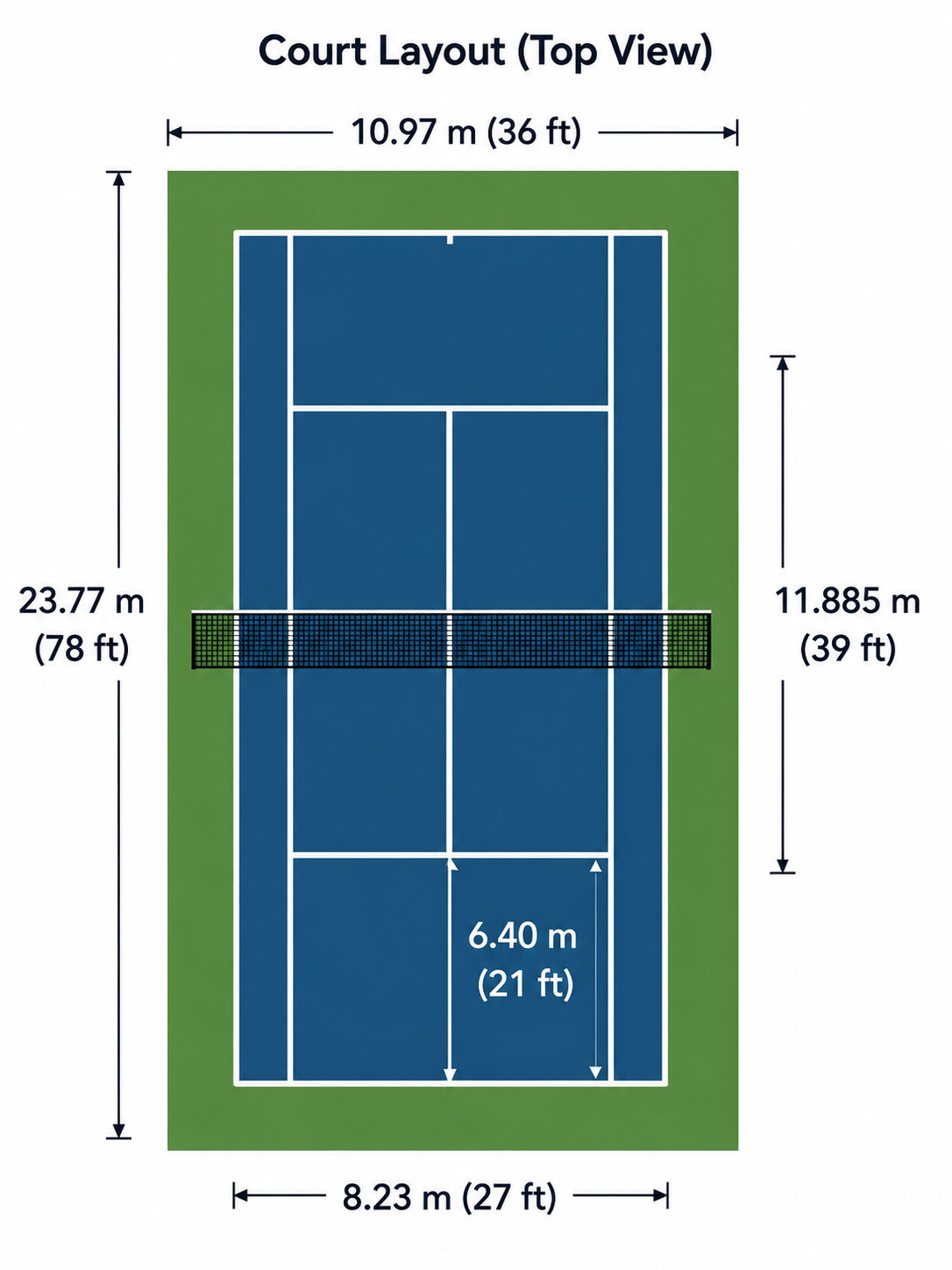
Singles Court Dimensions
A singles tennis court is designed for matches involving two players, with one player competing on each side of the net. It uses the inner sidelines of the full court, making the playing area narrower than a doubles court while maintaining the same overall length.
The official singles court measures 23.77 metres (78 feet) in length and 8.23 metres (27 feet) in width. The playing area is divided equally by the net, with each half measuring 11.885 metres (39 feet) from the net to the baseline. During singles matches, the outer doubles alleys are not part of the playing area.
Accurate singles court dimensions are important for maintaining fair gameplay, consistent ball placement, and compliance with official tennis standards. Whether the court is built with acrylic, clay, grass, or synthetic grass, these measurements remain the same.
Key Features of a Singles Court
- Official Playing Area: 23.77 m × 8.23 m (78 ft × 27 ft)
- Inner Sidelines: Only the inner sidelines are used during singles matches.
- Service Boxes: Two equal service boxes measure 6.40 m × 4.115 m each.
- Centre Mark: A 10 cm centre mark divides the baseline for accurate serving.
- Net Position: The net is placed exactly at the centre of the court, dividing it into two equal halves.
Official Singles Court Measurements
Official Size
Official Measurement
Total Court Length
23.77 m (78 ft)
Total Court Width
8.23 m (27 ft)
Distance from Net to Baseline
11.885 m (39 ft)
Service Line Distance from Net
6.40 m (21 ft)
Centre Service Line Length
6.40 m (21 ft)
Service Box Width
4.115 m (13.5 ft)
Centre Mark Length
10 cm (4 in)
Doubles Court Dimensions
A doubles tennis court is designed for matches with two players on each side. It has the same length as a singles court but includes the doubles alleys, making the court wider. These official dimensions are used for recreational, club, academy, and professional tennis courts worldwide to ensure consistent gameplay and tournament compliance.
Official Singles Court Measurements
Official Size
Official Measurement
Total Court Length
23.77 m (78 ft)
Total Court Width
10.97 m (36 ft)
Distance from Net to Baseline
11.885 m (39 ft)
Service Line Distance from Net
6.40 m (21 ft)
Centre Service Line Length
6.40 m (21 ft)
Service Box Width
4.115 m (13.5 ft)
Doubles Alley Width
1.37 m (4.5 ft) on each side
Key Features of a Doubles Court
- Official Playing Area: 23.77 m × 10.97 m (78 ft × 36 ft)
- Wider Court Layout: The doubles court is 2.74 m (9 ft) wider than a singles court, with 1.37 m (4.5 ft) doubles alleys on each side.
- Shared Service Boxes: The service boxes remain the same size as on a singles court and are used for all doubles serves.
- Outer Sidelines: The outer sidelines define the playing boundaries during doubles matches.
- Net Placement: The net is positioned at the centre of the court, dividing it into two equal halves.
Service Box Dimensions
The service boxes are essential playing zones that determine whether a serve is valid. Each tennis court has four service boxes, with two on each side of the net. They are formed by the service lines, centre service line, and the singles sidelines. During every serve, the ball must land diagonally in the opponent’s service box to be considered legal.
Official Service Box Measurements
Official Size
Official Measurement
Service Box Length
6.40 m (21 ft)
Service Box Width
4.115 m (13.5 ft)
Number of Service Boxes
4 (Two on each side of the net)
Centre Service Line Length
6.40 m (21 ft)
Distance from Net to Service Line
6.40 m (21 ft)
Key Features of the Service Box
- Equal Dimensions: All four service boxes have identical measurements.
- Diagonal Serving Rule: Every serve must land in the diagonally opposite service box.
- Centre Service Line: Divides each side of the court into two equal service areas.
- Consistent for All Matches: Service box dimensions do not change between singles and doubles play.
- Accurate Line Markings: Clearly marked lines help players and officials make correct line calls.
Tennis Net Specifications
The tennis net divides the court into two equal halves and is one of the most important components of a standard tennis court. It must be installed at the correct height and properly tensioned to ensure fair play, consistent ball clearance, and compliance with official tennis standards. The net extends across the full width of the doubles court and is securely supported by net posts positioned outside the doubles sidelines.
Official Tennis Net Measurements
Official Size
Official Measurement
Net Height at Centre
0.914 m (3 ft)
Net Height at Posts
1.07 m (3 ft 6 in)
Net Width
12.80 m (42 ft)
Distance Between Net Posts
12.80 m (42 ft)
Net Post Position
0.914 m (3 ft) outside each doubles sideline
Centre Strap Width
5 cm (2 in)
Centre Strap Height
Maintains 0.914 m (3 ft) net height
Key Features of a Tennis Net
- Standard Height: The net measures 0.914 m (3 ft) at the centre and 1.07 m (3 ft 6 in) at both posts.
- Full Court Coverage: The net spans the entire width of the doubles court, including the doubles alleys.
- Centre Strap: A centre strap keeps the net at the official height and prevents sagging.
- Proper Tension: The net should remain evenly tensioned to provide consistent ball rebound and clearance.
- Durable Construction: Most modern tennis nets are made from weather-resistant polyethylene or braided polyester for long-lasting outdoor performance.
Run-off Area
The run-off area is the clear space surrounding the tennis court that allows players to move safely beyond the playing lines during rallies. Although it is not part of the official playing area, it is essential for player safety, unrestricted movement, and tournament-quality court design. The required run-off space depends on whether the court is intended for recreational, club, or professional use.
Recommended Run-off Area Dimensions
Court Type
Recommended Overall Area
Recreational Court
34.75 × 17.07 m (114 × 56 ft)
Club & Academy Court
36.60 × 18.30 m (120 × 60 ft)
Professional Court
36.60 × 18.30 m (120 × 60 ft) or larger
Key Features of the Run-off Area
- Player Safety: Provides additional space around the court, reducing the risk of collisions with fences, walls, or other obstacles during play.
- Improved Movement: Allows players to chase deep and wide shots without leaving the safe playing zone.
- Recommended Clearances: Adequate space is maintained behind the baselines and along the sidelines for comfortable player movement.
- Suitable for Different Facilities: Run-off area requirements can vary for residential, club, academy, and professional tennis courts based on available space and intended use.
- Tournament Compliance: Larger run-off areas help meet the standards recommended for competitive and professional tennis events.
- Better Court Functionality: Extra surrounding space accommodates officials, coaching equipment, maintenance access, and court accessories when required.