Hard Tennis Court Surface
Explore everything you need to know about hard tennis courts—from surface types and acrylic systems to tennis ball behaviour, racquet specifications, court pace, drainage, Grand Slam surfaces, maintenance, and lifespan.
What Is a Hard Court Surface?
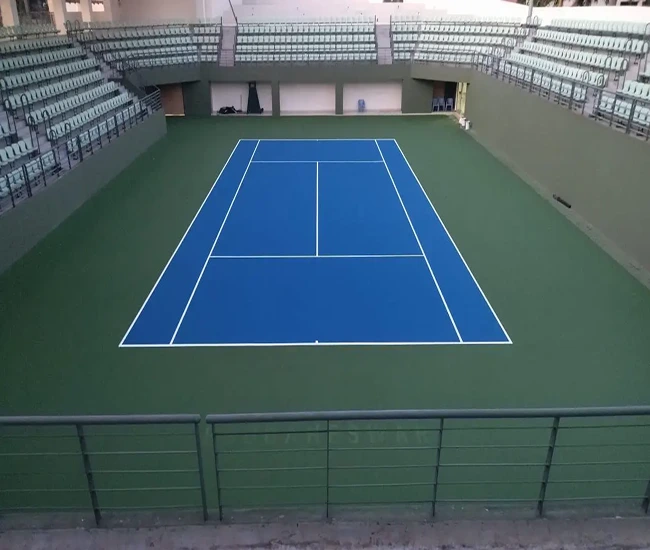
A hard court is one of the most widely used tennis court surfaces in the world. It is generally constructed over a firm base, such as asphalt or concrete, and finished with a multi-layer acrylic coating system. The playing surface is designed to provide a relatively consistent ball bounce, good durability, and predictable player movement.
Unlike clay courts, which allow players to slide naturally, or natural grass courts, which typically produce a faster and lower bounce, hard courts offer a balanced playing experience. The speed and playing characteristics of a hard court can vary depending on the base construction, acrylic coating system, surface texture, cushioning, and maintenance.
Hard courts are commonly found in public tennis facilities, schools, clubs, sports complexes, professional tournaments, and private courts. They can be built for both indoor and outdoor environments.
Types of Hard Tennis Courts
Concrete-Based Hard Courts
Concrete provides a rigid and stable foundation for a hard court. It is commonly used where a strong, long-lasting base is required
Asphalt-Based Hard Courts
Asphalt provides a strong and flexible foundation for a hard court. It is commonly used for outdoor courts due to its practical performance.
Acrylic Hard Courts
It provide a durable an & consistent playing surface. They are commonly used for reliable ball bounce & long-lasting performance.
Cushioned Acrylic Courts
Cushioned acrylic courts use elastic or rubberized layers beneath the acrylic surface to provide better shock absorption & player .
Indoor Hard Courts
Indoor hard courts are protected from direct exposure to rain, sunlight, and other outdoor weather conditions.
Outdoor Hard Courts
It is an open-air tennis court with an asphalt or concrete base & an acrylic surface, designed to withstand changing weather .
Tennis Ball Behaviour on Hard Courts
Hard courts provide a consistent and predictable ball response. Surface texture, court pace, temperature, and ball condition can all influence bounce, speed, and durability.
Ball Type
Standard pressurized tennis balls are commonly used for competitive and recreational play on hard courts surface.
Ball Weight
Standard tennis balls typically weigh between 56 and 59.4 grams, providing consistent performance during play.
Ball Diameter
Standard tennis balls typically measure between 6.54 & 6.86 centimeters in diameter for regulated play.
Bounce Behaviour
Hard courts generally provide a consistent and relatively predictable bounce across the playing surface.
Ball Speed
Court pace, surface texture, temperature, and ball condition can influence the speed of play.
Ball Longevity
Hard court friction can wear the felt faster, gradually affecting the ball’s performance and consistency.
Tennis Racquet on Clay Courts
The right tennis racquet can help players balance power, control, spin, stability, and comfort when playing on hard court surfaces.
Racquet Weight
Heavier racquets provide greater stability and power, while lighter racquets offer easier maneuverability and faster handling.
Racquet Balance
Head-heavy racquets provide more power and stability, while head-light racquets offer quicker handling and better maneuverability.
Head Size
Larger racquet heads provide a bigger sweet spot and more power, while smaller heads offer greater control and precision.
String Pattern
Open string patterns provide more spin and power, while dense patterns offer greater control and improved string durability.
HARD COURT SLOPE & WATER DRAINAGE
A properly designed slope is an essential part of a hard tennis court, helping direct rainwater away from the playing surface and toward the appropriate drainage areas. A smooth and consistent slope prevents water from collecting on the court, reducing the risk of puddles, surface damage, and slippery playing conditions. When combined with an effective drainage system, the correct slope helps maintain a dry, safe, and playable court while supporting consistent ball bounce and extending the overall life of the playing surface.
1. One-Direction Slope
The entire court surface gently slopes in one direction, allowing rainwater to flow toward a designated edge or drainage channel.
Best For:
Courts designed with drainage along one primary side.
2. Two-Direction / Crown Slope
The court surface slopes gently away from the center toward both sides, directing water to drainage channels along the edges.
Best For:
Courts where drainage is provided along both sides of the playing area.
WHY IS COURT SLOPE IMPORTANT?
Court slope is essential for maintaining the performance, safety, and durability of a hard tennis court. It directs rainwater toward the drainage system, preventing water accumulation, protecting the surface, and ensuring safe, consistent playing conditions.
Prevents standing water
Directs rainwater away from the playing surface, helping prevent puddles and standing water after rainfall.
Protects the surface
Reduces prolonged water exposure, helping protect the court from moisture-related surface damage over time.
Improves player safety
Keeps the court cleaner and drier, reducing slippery areas for a safer playing environment.
Maintains playing quality
Prevents water accumulation, helping maintain consistent ball bounce & reliable court performance.
GRAND SLAM TOURNAMENTS ON HARD COURTS
Two of the four Grand Slam tournaments are played on acrylic hard courts. These tournaments offer consistent ball bounce, balanced court pace, and durable playing conditions, making them ideal for aggressive baseline players and all-court playing styles.
🇦🇺 Australian Open
🎾 Surface
Acrylic Hard court
⚡ Court Pace
Medium–Fast
📍 Location
Melbourne, Australia
Played every January, the Australian Open is the first Grand Slam tournament of the year. Its acrylic hard courts provide a consistent bounce and medium-fast playing pace, creating reliable conditions for professional competition.
🇺🇸 US Open
🎾 Surface
Acrylic Hard court
⚡ Court Pace
Medium–Fast
📍 Location
New York, USA
The US Open is the final Grand Slam tournament of the year, held on acrylic hard courts in New York. The surface provides a consistent ball bounce, medium-fast pace, & long-lasting durability, supporting aggressive baseline play, powerful serves, & fast-paced rallies .
Frequently asked questions
Still have a questions?
Can’t find the answer you’re looking for? Visit our Contact page and send us your question using the contact form. We’ll review your query and consider adding it to our future guides and FAQ updates.
Yes, hard courts can be marked and used for sports like pickleball, basketball, and volleyball.
Poor drainage and delayed crack repairs are among the most common causes of surface deterioration.
Bitumen (asphalt) is often preferred because it provides better flexibility, faster construction, and a smoother playing surface, while concrete offers greater rigidity and durability.
No, the surface should be completely dry before play resumes to ensure safety.
Small cracks can expand over time, affecting surface appearance, playability, and durability.